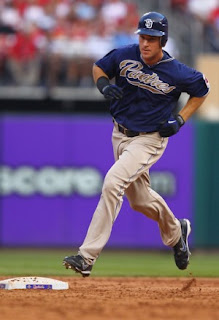
Showing posts with label Hot Stove. Show all posts

Tuesday, January 17, 2012

Rounding Out the Outfield

The Reds have signed veteran outfielder Ryan Ludwick to their 2012 efforts with a $2.5 million contract and a nominal mutual option for 2013. The contract has up to $500,000 in performance incentives and affordably adds much-needed depth to the Reds outfield. Ludwick can play either corner outfield spot, giving the Reds the flexibility to slide Chris Heisey to center to spell Drew Stubbs when needed without compromising depth behind Jay Bruce. With less severe lefty-righty hitting splits than the young Heisey, Ludwick adds a more consistent and versatile option to the outfield mix while adding very well-regarded veteran leadership to the clubhouse.

Ludwick spent most of his major league career with the Cardinals and had his career year with them in 2008, batting .299 with 37 homeruns and 113 runs batted in. It goes without saying, though, that hitting in front of Albert Pujols probably benefited the outfielder to a certain extent. Still, Ludwick is a career .261 hitter with power who, other than the last few years, was good for an OPS of at least .775. Sluggers who can power in 100+ or even 75+ RBIs a season don't typically go for $2.5 million, though, and his performance in recent seasons is the biggest factor in his diminished value.

Did Ludwick Lose his Pop?

Ludwick is coming off a few disappointing seasons, where he spent most of his time in San Diego's monstrous Petco Park. During that time, the traditionally slugging Ludwick had some potentially concerning trends with his isolated power numbers, which is a hitter's slugging percentage minus his batting average per at bat. The metric measures the extra base hits that a hitter averages per at bat and is a better measure of a batter's pure power than slugging percentage, which factors singles into the equation. Where Ludwick hovered around a respectable .200 ISO during his time with St. Louis, he never exceeded .135 in San Diego or in his cameo appearance for the Pirates during the second half of last year. The major league average, even taking soft-hitting shortstops into account, has hovered around .150 since 2002.

That decline is certainly not a good power trend to be coming off of. Still, it's difficult to isolate Ludwick's decline strictly to his power all of a sudden being sapped. The righty really didn't change his tendencies as a hitter during the last three years, posting consistent line drive, flyball, strike-out and walk rates even as his power numbers seemingly began to suffer.

A culprit worth noting in this decline was Ludwick's batting average on balls in play, which may be more of a symptom than a driver of his poor statistics in this case. Where the general league average is around .300, Ludwick never managed a BABIP above .277 since leaving Saint Louis, which isn't a fall off the cliff, necessarily, but isn't the norm for a 20% line drive hitter. The big contributor to that discrepancy may lie in what Ludwick does with the other 80% of his batted balls, namely his tendency to hit a lot of flyballs.

Petco Park has some of the deepest outfield dimensions in baseball and in addition to spending most of his last two seasons there, Ludwick spent a lot of time playing division games in also-cavernous Los Angeles and San Francisco. For a flyball hitter in a pitcher's park, good contact hits that may be homeruns in other parks most often turn into deep fly outs. In Petco's case, lefties are much more suppressed than righties like Ludwick on homeruns, but both are suppressed more in San Diego than most parks in the majors. If fewer balls are leaving the park and becoming outs instead, it not only will suppress the traditional average and slugging numbers, but it reduces the hitter's production in the true outcome events that are measured in BABIP.

Locations of all homeruns (blue) and fly outs (orange)
hit in Petco last year, overlayed on Great American Ballpark
Great American Ball Park is the antithesis to Petco and may, in fact, be a better fit for Ludwick's tendencies than even other hitter's parks. While Great American isn't necessarily shallow in left-center or center field where Ludwick hits many of his homeruns, it's much shorter down the line at 328 feet and more friendly in the gap at 379 feet. Great American Ball Park has one of the best homerun park factors for righties in baseball at 133, a pretty large jump from Petco's 95.

To partially illustrate some of these differences, take a look at the image to the right. This park map charts the locations of all homeruns (blue) and fly outs (orange) hit in Petco last season, overlayed against the dimensions of Great American Ballpark. While this doesn't tell the whole picture, it's worth noting that if you similarly chart just Ludwick's homeruns and fly outs from last season, two of his fly outs would have been homeruns in Great American's right field.

What to Actually Expect

It would be foolish to expect a heroic renaissance of epic proportions like the season Ludwick had in 2008, especially in the number of plate appearances he will likely get by comparison. It's hard to weigh the specific causes of some of Ludwick's issues in the last few years, so it's tough to lay his reduced numbers strictly at the feet of Petco's large outfield dimensions. That said, the switch of parks alone should make Ludwick a much more valuable contributor in 2012 considering his low price tag.

If he can hit close to his career average while maintaining a .775+ OPS and an .200+ ISO, Ludwick could easily add one or two wins to the Reds efforts in 2012. It will be interesting to see how time is divided between he, Heisey and Stubbs, though. While it's safe to say Bruce is anchored in right other than a day off here and there, Heisey may see some increased playing time in center based on matchups. It wouldn't be out of the question to see all three of Ludwick, Heisey and Stubbs seeing north of 400 plate apperances in 2012, but as always, player production will tell the tale.

Thursday, January 12, 2012

Reds Find Their Closer in Madson


The Cincinnati Reds have agreed to add free-agent closer Ryan Madson, answering the closer question raised by Francisco Cordero's departure and providing another shot in the arm to the 2012 roster. After trying to come to an agreement with Cordero over the last few weeks, Reds GM Walt Jocketty gave the closer and his agent a soft deadline to come to a consensus. As of Tuesday, the club was downplaying interest in Madson, but with the closer market relatively dry at this point, the Reds were finally able to come to terms with the righty's agent Scott Boras, ending their pursuit of Cordero.

In 2012, Madson will be due about $6 million by the club, half of what Cordero would have made had the Reds picked up his option for this season. In 2013, there is a mutual option for $11 million, with a $2.5 million buy-out should the Reds decide to go in another direction. It's no small feat to land a one-year deal for a Scott Boras free agent, especially when the player in question was linked to a four-year, $44 million deal with the Phillies earlier this year

The Numbers Don't Lie

In terms of converting saves, Madson was the third most efficient reliever in baseball for the Phillies in 2011, converting 32-34 of his save opportunities as Brad Lidge dealt with injuries for most of the year. He was notably terrific against left-handed hitters, holding them to a .198 batting average and a .506 OPS. Madson maintained a 2.37 ERA and a 9.7 K/9 ratio through his 61 innings, where he induced a ground ball rate just short of 49%. 


Other than a mid-90's fastball, Madson has a deadly change-up in his arsenal as a true put away pitch. He threw the pitch more than half of the time on two-strike counts last year with lethal results. The pitch had the second largest amount of break to the right of change-ups in baseball, was out of the strike zone nearly 75% of the time, but was still swung at more than 65% of the time. Most importantly, the pitch was only put into play about 25% of the time. This is a significant advantage for a righty closer since the change-up is arguably the most effective neutralizing pitch against left-handed hitters, as reflected in Madson's other peripherals.


Bringing the Offseason into Perspective

While debate will almost certainly continue around the number of prospects the Reds parted ways with in the Latos and Marshall trades, it's important to consider their impact on the larger offseason and this deal. If the Reds are particularly committed to winning in the remaining two years of Votto's contract, Madson's addition adds to the number of options the team has to compete with during that time. In addition to having the option of extending Marshall, the Reds now have another bona fide late-inning reliever in Madson under club control to consider going into 2013. The move can also let the team comfortably try Aroldis Chapman as a starter in the minor leagues to finally assess his value in that role in the future.

There's a number of factors that will contribute to the team's decisions beyond the 2012 season, from attendance bumps to (hopefully) playoff revenue. But in the time the team is guaranteed to have with Votto, they have maximized their number of quality options to go forward with, or not. But for this season, the acquisition has arguably given the Reds one of the better bullpens in the National League. Where Cordero was a solid but perhaps declining contributor, the money saved by not extending him brought a combined 4.5 WAR in Madson and Marshall, and gave the team flexibility to consider their options as they go "all in."

Take a look at the numbers of some major relief contributors from 2011 (FanGraphs):


WLSVGIPK/9BB/9HR/9ERAWAR
Sean Marshall6657875.29.42.020.122.262.8
Ryan Madson42326260.29.22.370.32.371.7
Bill Bray5307948.18.193.170.562.980.7
Nick Masset3617570.17.933.970.643.710.6
Logan Ondrusek5506661.16.024.110.883.23-0.2

Sunday, January 1, 2012

What's Left on the Farm?

The arrival of Mat Latos and Sean Marshall has improved the outlook and expectations for the 2012 Reds season, but came at the expense of some highly coveted prospects. In the trades that brought Latos and Marshall over, the Reds parted with Yonder Alonso, Yasmani Grandal, Brad Boxberger, Travis Wood, Dave Sappelt and Ronald Torreyes. Alonso and Grandal were both first round picks and ranked fourth and sixth respectively in Baseball America's 2011 top prospect list. Prior to being packaged in the Marshall trade, Torreyes projected to be on the team's 2012 list. Excluding players like Devin Mesoroco, Zack Cozart and Todd Frazier who saw some fairly significant playing time in 2011, here's a look at five of the Reds' top prospects following the Latos and Marshall deals.


Billy Hamilton - Shortstop
Billy Hamilton had an astounding 103 stolen
bases for the Dayton Dragons last year.
Other than the excluded Mesoroco, Hamilton is in line to be the Reds next top prospect and figures to be in the middle infield mix as the Reds move forward in the next few years. His success will largely hinge on Hamilton's ability to improve his contact rate, allowing him to truly take advantage of his elite speed. After 610 plate appearances in 2011, Hamilton had stolen a whopping 103 bases and ended up with a steal virtually every other time he reached base. He has a strong batting average on balls in play, but had a fairly unspectacular .340 on-base percentage last year, due largely to his 133 stirkeouts - all in single A Dayton, where pitching talent hasn't yet developed to the major-league level. If Hamilton can improve his strikeout and walk numbers, he has the raw tools to make him an intriguing future leadoff option with base-running speed to burn. For now, expect him to start his 2012 season in high A to work on those peripherals.


Daniel Corcino - Pitcher (R)
Right-handed pitching prospect Daniel Corcino is arguably the top arm in the current Reds system, though he may still be several years away from contributing at the major-league level. Corcino pitched in single A during 2011, securing an 11-7 record with a 3.42 ERA. In just under 140 innings, Corcino issued a mere 34 walks, while fanning 156 batters in that time. He has a strong mid-90's fastball and works in a slider and changeup to keep opposing hitters off-balance. That said, his smaller frame (5' 11" and 165 pounds) may make his inning-eating durability a question mark in the future based on his body of work. 2011 was the first year that Corcino eclipsed the 100 inning mark and he will likely be stretched out further in high A to start the 2012 season.


Robert Stephenson - Pitcher (R)
The 18-year-old Robert Stephenson was the 27th overall pick in the 2011 draft after throwing back-to-back no-hitters for his high school team. Stephenson has a mid-to-high-90's fastball that Reds scouts clocked at as high as 98 mph. With a strong curveball, Stephenson will likely work to develop his third offering in low A ball this season to improve his total command of the strike zone. With a projectable frame, his peripheral qualities and arsenal could help Stephenson advance through the minors quickly in the years to come.


DiDi Gregorius - Shortstop
A European prospect from Amsterdam, Gregorius finished 2011 with the AA Carolina Mudcats after 46 games with A+ Bakersfield, where he hit .303 with a .457 slugging percentage in 203 plate appearances. In a combined 336 at-bats, he only struck out a respectable 50 times. Improving his walk rate should improve his .324 OBP and will be an area of focus for the shortstop with the Mudcats this season. His production dropped slightly after advancing to Carolina last year, where he hit .270 in 160 plate appearances. Despite the small sample offensive splits, his glove work remained a plus asset for the young infielder at both levels of competition. Based on his production and ability to improve his overall strike zone management, he could be a candidate for AAA promotion sooner than later.


Neftali Soto - First Base
Neftali Soto lead all Reds minor-leaguers
with 31 homeruns in 2011.
With the departure of Alonso, Soto would seem to be the in-house heir apparent for Joey Votto at first base should he leave the team after his current contract expires. Originally drafted in 2007, Neftali was a slow riser through the Reds minor league system, but displayed marked improvements to his numbers over the last two seasons. Soto has greatly improved his power potential, and had 31 homeruns in two levels of competition last year, where he powered in 80 runs in 396 at-bats. He has room to improve his walk and strikeout numbers, drawing 23 and 98 respectively in 432 plate appearances last season. Soto is not a particularly outstanding defender, but has seemingly found a home at first which could contribute to a sense of consistency for improvement. While there are holes to improve in his lunging swing, Soto will begin the year in AAA and may be in the mix to contribute to the major league club should team injury or his own production prompt a move. 

Wednesday, December 21, 2011

Out Goes Wood, In Comes Marshall

Sean Marshall has lead all major-league
relievers in WAR with 5.0 since 2010
Well, I apparently picked a good week to start this little love affair of a blog. On the heels of this weekend's acquisition of Mat Latos, the Cincinnati Reds have agreed to a trade with the Chicago Cubs that will send Travis Wood and prospects Dave Sappelt and Ronald Torreyes to Wrigley in exchange for lefty reliever Sean Marshall.

Marshall has, in terms of wins above replacement, been the single most valuable reliever in baseball over the last two years, averaging 2.5 WAR each season - a pretty staggering statistic for someone used primarily as a setup man. The 29-year-old, once-starter has spent his entire career with the Cubs to this point. After fully converting to a reliever in 2010, he broke out as one of the best relief talents in the National League. Over 150 innings, he has posted a 2.45 ERA. In that time, he has given up 22 doubles, one triple and just four homeruns. In 75 innings last year, he gave up just one homerun and 19 earned runs while facing 307 opposing batters and striking 79 of them out.

Travis Wood came on the scene in 2010 and had an impressive rookie campaign for the Reds, going 5-4 in 17 starts with a 3.51 ERA. Interestingly, he made his debut against the very club he is now about to play for, holding the Cubs to two hits and two runs. In just his third big-league start, Wood came within three outs of throwing the second perfect game in Reds history, but instead ended up with a no-decision in an eventual 1-0 loss to the Phillies. His sophomore season wasn't quite as rosy, with Wood going 6-6 in 18 starts with a 4.84 ERA. He spent time in AAA Louisville, pitching ten games and going 2-3 with a 5.33 ERA. Still, the young southpaw has displayed moments of brilliance in his short career and stands to be at worst a solid back of the rotation solution for the Cubs going forward.

In these deals, however, there is always a rub in projecting value. This time around, it all has to do with contract length. Marshall is going into his contract year and stands to be a free agent in 2013. With the Reds' payroll constraints and the money Marshall will be able to command as a premium reliever, it may be difficult to extend him beyond this season. Wood, on the other hand, is under team control through 2016. With the new Collective Bargaining Agreement, Cincinnati won't even get a compensation pick for Marshall should he choose to walk after his contract is up unless the trade makes an outrageous arbitration offer. If the Latos trade polarized the Reds fan base, this one has truly left Cincinnati fans as a house divided because of these disparities.

Facing Facts

There's no question that this is a shorter-term move for the Reds, further signifying the "all in" mentality I mentioned in the earlier post about Mat Latos' arrival. It's entirely debatable whether it was the right move and, as is always the case in baseball, 162 games will sort out right from wrong. That said, for all Wood's potential, he wouldn't have the same opportunity to succeed with Cincinnati that he will elsewhere. While the same was true about Yonder Alonso and Yasmani Grandal by virtue of being blocked at their positions, Travis may not have been a good fit for reasons beyond that.

Great American Ballpark is a hitter's park that by its nature is particularly unforgiving to flyball pitchers like Travis Wood. In 106 innings last season, Wood had a low groundball rate of 32.1% and while he put away a respectable 6.5 batters with strikeouts per nine innings, his sub .65 flyout to groundball ratio doesn't project well for the small confines of Great American Ballpark. His home and away splits support this reality, with Wood posting a 5.86 ERA at home last year, almost a full two points above his 3.90 ERA on the road in a similar sample of innings pitched. While he gave up a similar number of hits at home (60) and away (58) in 2011, he gave up four times as many homeruns in Great American as he did on the road, in part resulting in 33 earned runs versus 24 in other ballparks. With Latos' arrival, he was simply the sixth man in a five-man ' rotation and the team moved him for Marshall who should contribute to a larger extent in 2012.

The addition of a reliever of Marshall's caliber and the ongoing vacancy for the Reds closer role begs the question of whether the club would consider him for that spot or not. While it is certainly a possibility based on his FIP and while bullpen roles are often subject to change over the course of a year (see Saint Louis Cardinals, 2011 World Champions), I think Marshall will primarily serve as a setup man for the Reds. While you have to take sample sizes with a grain of salt, here are the numbers of opposing batters against him last year, with plate appearances in parentheses:
  • Seventh inning:  .198/.244/.247 (59 PA)
  • Eighth inning:  .220/.259/.265 (140 PA)
  • Ninth inning:  .340/.375/.396 (87 PA)
I won't get into baseball's eternal debate about whether any good reliever can perform well closing games and pitching in the ninth inning. For all intents and purposes, though, some pitchers are just plain better suited for certain roles. And in a setup role for the last two years, Sean Marshall has empirically been one of the best relievers in baseball.

What Still Might Be Cooking

Since you could almost argue for or against a one-for-one trade for Wood and Marshall based on Chicago's desire to start rebuilding, the inclusion of minor leaguers Dave Sappelt and Ronald Torreyes might signify that the Reds hope to extend Marshall beyond 2012, if possible. He is due $3.1 million in 2012 which is expensive in terms of replacement relief talent, but still more than reasonable for his abilities. The team may have wanted to secure team control for a potential extension during the season before the talented Marshall would hit free agency, where bidding might be competitive.

Dave Sappelt hit .564 in Spring
Training for the Reds last season
Sappelt had a monster line at Spring Training last season, hitting .564 in 38 at-bats with three homeruns and 12 RBI. He spent most of the season in Louisville playing center field and hitting .313 with seven homeruns and a .358 average against lefties. He was called up to the Reds in early August after Chris Heisey injured his oblique and appeared in just under 40 games, going .243 with only 5 RBI.

With Heisey in line to play a part in the left field equation this season, Sappelt was a potential platoon option to spell Heisey's issues with hitting left-handed pitchers. Jocketty has indicated that addressing that platoon issue through free agency is still a potential objective this offseason, along with potentially addressing the bullpen situation further.

The speedy Torreyes was a huge contributor in high-A Dayton last season, hitting .356 with a .457 slugging percentage in a relatively small sample. He converted his 99 hits in for 41 runs batted in and showed tremendous plate discipline for a 19-year-old with a 6.2% strikeout ratio. While he may maintain above average batting averages on balls in play from his speed, his limited frame and tendency to hit singles may not have fit the mold for the Reds plans going forward. His inclusion bolsters the Cubs depth at that position, but shouldn't be a huge detriment for the Reds - especially if they extend Brandon Phillips and hold onto coveted prospect Billy Hamilton, who duplicates many of Torreyes' tools.

As it stands, Jocketty has effectively added one of the better young pitchers in the National League (Latos) and arguably its best left-handed reliever (Marshall) without taking on any net difference in team payroll. The expense was a large part of the nucleus of the Reds' premium prospect base, albeit at positions of depth. If the Reds intend to convert flamethrower Aroldis Chapman to a starter as they've indicated, that means that Sam LeCure is now arguably the club's best option for a spot start until Chapman stretches his innings out, likely in AAA.

Buckle up for 2012.

Tuesday, December 20, 2011

Welcome Mat Latos

24-year-old Mat Latos boasts a
career 3.37 ERA
It seems an appropriate time to launch a labor-of-love blog largely about the Cincinnati Reds on the heels of their largest team deal in the Walt Jocketty era. Sorry Scott – we all love you – but Saturday’s trade for San Diego righty Mat Latos had the number of pieces flying around that signature trades are made of, for better or worse. The move gives the Redlegs a healthy one-two punch of Cueto-Latos at the top of their pitching rotation in 2012 while the club affordably maintains team control of the young pitcher for the next four years.

The trade is one that has polarized a lot of opinions of Reds fans and baseball analysts alike due to the high cost of bringing Mat to Cincinnati. The Reds sent highly-touted prospects Yonder Alonso, Yasmani Grandal, Brad Boxberger and pitcher Edinson Volquez to San Diego, effectively signifying that the Reds first priority is to make a run at it during Joey Votto’s final contract years. There’s no question that top of the rotation pitching was a need for the Reds this offseason and after being involved in rumors with James Shield, Jair Jurrjens and Gio Gonzalez, they finally had a deal they could pull the trigger on.

In addition to filling out a spot in the rotation going into 2012, Mat Latos comes with four years of team control and the move saved the Reds a few million dollars to potentially play in free agency with. But as is always the question with such a trade, you have to wonder who won. And the answer is, well, that it’s hard to answer. But I’ll try to add some context to the deal.

Cost-Benefit Analysis

I want to go on record saying that in four years, or perhaps even sooner, the Padres are going to be able to look at this trade on paper and make the argument that they got the better value in the end. Alonso’s burst onto the scene in late 2011 backed up a stellar minor league resume that had the young first basemen ranked as the club’s third best prospect by Baseball America. The loss of catcher Yasmani Grandal, the fourth-ranked prospect, was another shot to the depth of the current farm system. That said anyone who has been following the swirling speculation around the Reds' desire to trade for a top of the rotation arm had to just about see the writing on the wall for those two prospects if such a deal was going to be struck.

Prospect Yonder Alonso is among the four
Reds heading to San Diego.
With former-MVP Joey Votto anchoring the Reds at first through 2013 and top prospect Devin Mesoroco projected to play a prominent role in the Reds 2012 catching battery, both Grandal and Alonso were blocked from contributing significantly for the next few seasons. While the club kicked the tires on Alonso in left field, you never quite got the feeling that they were comfortable with him there full time due to his less than premium defense. 

Also headed to San Diego are reliever Brad Boxberger and the enigmatic Edinson Volquez. Boxberger was really starting to come into his own in the minors last year and seemed destined to make the Reds bullpen sooner than later. Of all the pieces involved in this trade, Brad was perhaps the most unexpected. But, Reds GM Walt Jocketty said shortly after the trade that he didn’t “think we would have been able to make the deal” without him. At the end of the day, it’s hard to get too hung up on trading away a reliever for a power pitching potential ace along with surplus pieces to the organization.

Reds nation basically ran completely out of patience of the 28-year old Volquez after his Opening Day nod last season. After being acquired through the infamous Josh Hamilton trade, Volquez had a stellar debut for the 2008 Reds posting a 3.21 ERA and a 17-6 record along with a trip to the 2008 All-Star game. It’s safe to say that as far as the Reds are concerned, Edinson peaked early. Following a PED indictment, Tommy John surgery and a 2011 campaign that saw him demoted to AAA Louisville not once, but twice, a change of scenery will probably do well for both the Reds and Volquez alike, who stands to benefit from the cavernous dimensions of Petco Park.  

The return for the Redlegs is a 24 year old pitcher with potential one or two in the rotation stuff. Latos has four pitches in his arsenal with a low-to-mid-90’s fastball and career 3.37 ERA. After a stellar 2010 that saw the right hander go 14-10 with a 2.92 ERA, Latos had consistency issues in the first half of 2011 and had lost a few miles per hour from his velocity going 5-10 through his first 17 games with shoulder issues. But he seemed to have really found his groove after the Midsummer Classic, posting a 2.87 ERA through the final fourteen games and pushing his strikeout-to-walk ratio to nearly 4. He had a WHIP ratio of 1.00 and nearly averaged one strikeout for every inning pitched.

The Smallpark Beckons

There is usually a deserved guard that goes up when conversations around San Diego’s pitching come up. Indeed Petco Park is arguably the most pitcher-friendly park in baseball, despite it being edged out by Tropicana Field and AT&T Park in MLB park ratings. Even casual Reds fans are fairly well-aware that the opposite is true in Cincinnati. Great American has been called a “bandbox” and is endearingly referred to as “Great American Smallpark” by Cincinnatians with good taste. While pitching in Petco is worlds away from pitching at Great American, there is plenty of evidence that Latos is well-equipped to overcome the change in ballpark dimensions. 

It is worth noting that Latos’ peripherals have been better at home than they have on the road in his career… but barely. Last season, Latos had a 3.24 ERA and a 3.50 strikeout-to-walk ratio in the confines of Petco, while going 3.68 with a 2.61 SO/BB on the road. Over his three year career, he’s managed a 3.11 ERA in San Diego and a 3.57 mark on the road. There is discrepancy there, some of which can certainly be written off to Petco. But his peripherals indicate that Mat Latos could manage just fine in another ballpark.

Latos’ fielding independent pitching number is 3.28 over his career and he is in a position to maintain a continually low batting average on balls in play due to Cincinnati’s stellar defense. The home-away splits are not drastically out of line with what you would expect any home-away split to be, ballpark dimensions aside. His peripherals were virtually consistent whatever venue he was playing in. In fact, his homerun total in his career is almost inexplicably higher at Petco than it has been on the road. It is also worth noting that he has pitched almost 60 more innings on the road than at home in his career.
 
In his career, Mat has given up about .8 homeruns per nine innings pitched. This number isn’t staggering or particularly exceptional by any means, but it thankfully isn’t Bronson Arroyo territory either. Last year, Latos struck out over 8.5 batters per nine innings and walked an average of three per nine. He posted a groundball percentage of 43% and though he is also a bit of a fly ball pitcher at times, his strong strikeout numbers should keep him balanced enough to overcome the new park. Last year, despite a rougher first half, he had a better groundball to flyball ratio than Clayton Kershaw. Splits aside, even looking at the "away" statistics for SO/BB (2.61) and ERA (3.68), Mat's numbers are both better than Cueto's career averages, who stands to continue to improve as well.

At a great cost, the Reds have certainly upgraded their rotation with this move and Latos could easily project to be a 4 – 4.5 WAR arm and 15 or 16 game winner in Cincinnati should the Reds bounce back as a team from a disappointing effort in 2011.

Some Final Thoughts
  • Yonder Alonso on paper didn’t seem like a great fit for the Padres who acquired 22-year-old first base prospect Anthony Rizzo when the team moved Adrian Gonzalez to Boston. Rizzo hit .331 with 26 homers and 101 RBIs in AAA before hitting .141 in San Diego towards the end of the last season. Rizzo struck out 46 times, but only has a 128 at-bat sample. With Yonder not being a good fit for Cincinnati’s left field, it’s hard to imagine him ending up in Petco’s large outfield corners. Expect the Padres to trade one of the two pieces with teams like Chicago, Toronto and Tampa in need of a long-term answer at first.

  • Edinson Volquez is a pitcher who stands to greatly benefit from his move to San Diego. Volquez achieved a hard to achieve feat last year posting a homerun to fly ball ratio north of 20%. Assuming he can continue to improve on his walks another year removed from Tommy John, the larger dimensions of Petco should substantially contribute to keeping more balls in the yard. With a hole in their rotation now, don’t expect the drop-off from Latos to Volquez to necessarily be as significant as it may seem. That said, the Padres have much, much larger issues that would likely have limited Latos’ value next season as well.

  • To me, this is a classic quantity-for-quality win-win trade and I expect both teams to get good value out of it. With the rest of the NL Central in a bit of a transition, the time has never been better for the Reds to deal from surplus to open a window. If they can do well over Votto’s final two seasons (and Latos should help), we can only hope team revenue and attendance will increase to continue a competitive run for the second half of Mat’s four years of team control.