Showing posts with label Outfield. Show all posts

Thursday, March 15, 2012

Utilizing the Utility Guys

It's less than three short weeks until the Reds begin their pursuit of another winning season. While the roster has begun to optimistically take shape for 2012, several minor questions are still being worked out in Arizona, including which utility players will round out the Opening Day 25-man roster. While you could perhaps argue that its a five-man battle for two roster spots between Willie Harris, Wilson Valdez, Paul Janish, Juan Francisco and Todd Frazier, its more realistically a battle of two players for one spot, if anything.

The Outfielders
Chris Heisey stands to play a
large role in the left field platoon

It's generally good practice in the National League to carry a second catcher, second third baseman and reserve utility infielder into the season with you. Without compromising pitching depth, it's tough to have room for more than a fourth outfielder.

Bringing in Willie Harris was a great depth move by Reds GM Walt Jocketty this offseason,  but his toolset (and contract terms by comparison) probably won't be enough to upend also acquired Ryan Ludwick for the fourth outfield spot. Harris will likely see some time with the Major League club at some point or another in the case of injury, but with a minor league deal he will mostly provide organizational security from AAA Louisville and be called on when needed in the outfield.

Harris is a career .240 hitter and doesn't bring much power to the table. He hit .246 with a .668 OPS for the Mets last year in 283 plate appearances. With good plate discipline, he draws a lot of walks which have helped keep his on-base percentage above .340 for the last five years. Even though he will mostly factor into the outfield depth situation, it's worth noting that he is also a capable infielder in a pinch. While Harris was similarly... we'll say "serviceable" to Ludwick on a per at-bat basis last season, he's coming off several seasons in a fairly limited role and a comparable minor league deal with the Mets in 2011.

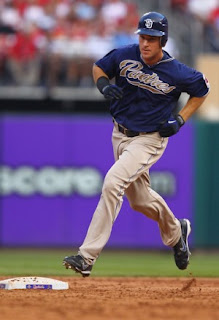
As I discussed earlier this year upon Ludwick's arrival, he may stand to greatly improve his numbers spending most of his time in Great American Ballpark. Cincinnati's 133 ballpark homerun factor for righties is almost tailor made for Ludwick's tendencies. In the 30 games he's played there in his career, Ludwick has hit nine homeruns, powered 21 runs in, managed a .276 batting average and posted a .921 on-base-plus-slugging. In a lot of ways, though, it's unfair to call the Reds' fourth outfielder a utility contributor, especially when he's a veteran on a Dusty Baker team. When all is said and done, Ryan Ludwick may tip the playing time balance away from Chris Heisey in left field by season's end, for better or worse, based mostly on his veteran status. With both left fielders struggling in Goodyear so far - Heisey has hit .130 with 11 strikeouts while Ludwick has hit .190 with 7 K's - it's hard to make that prediction with total conviction this early on.

“Obviously if one of us is hot, we’ll stick with that guy for a while.” Heisey said about he and Ludwick in left, adding that, "Right now, I don’t think one of us is going to get buried on the bench unless one of us is really struggling.”

The Infielders

Paul Janish likely played his way out of backup shortstop consideration last year, in spite his defensive prowess. The arrival of Wilson Valdez, who can play almost any infield or outfield position and arrives without options should figure to keep Janish off the 25-man as well.

All told, this means it's probably more of a Spring Training battle between Francisco and Frazier for the right to back up superveteran Scott Rolen at third with also-veteran Miguel Cairo. With Rolen's history of injury problems this is a fairly significant role for the  Reds' hopes to contend in 2012 and might represent 200-250 at-bats for the club.
Todd Frazier may give Juan
Francisco a run for his money
backing up Scott Rolen

Francisco arrived to camp later than some of the other "on the bubble" utility players, and reportedly drew some concern from Reds management. While Francisco has performed well enough since then, Frazier earned some brownie points with the club by reporting early and has motored along with a .280 average over 25 plate appearances while leading the club in homeruns (3) and RBI (8). Spring training numbers don't necessarily matter all that much (see: since traded Dave Sappelt, 2012), but there is some potential debate between the two back-up third basemen beyond their performances in half a season in the Cactus League.

Frazier is a more versatile reserve player and can cover all the spots around the horn in the infield, as well as play some corner outfield. Francisco may be able to play beyond first and third, but hasn't gotten any time away from the hot corner this Spring or in most of his Major League appearances to date. In 121 plate appearances last season, Frazier hit .232 but struggled from a below-average .253 batting average on balls put in play. He hit 6 homeruns and had 15 RBIs. Francisco hit .258 in 97 plate appearances for 3 homeruns and 15 RBIs himself. He posted a higher-than-average .318 batting average on balls in play, but given his power tendencies, the free-swinging Francisco will likely always be above league average in this category. Frazier's tools are a little more diversified, so the question is whether his production and versatility combined would trump Francisco's raw power alone, especially with a BABIP more in line with league average and Frazier's body of work in the minors.

The likely trump card in this conversation, barring a trade, is that Juan Francisco is out of minor league options as well. With more power than arguably anyone in the organization, it's unlikely the Reds would be able to retain the young prospect if he was designated for assignment and made it to waivers. While Frazier's stock would probably keep him from clearing waivers in a similar circumstance, the club can still move him freely between the 25-man and 40-man active rosters for now. He's also a right-handed hitter where Francisco hits left-handed. While this may actually have been a boon for Frazier's chances to make the club out of camp a few years ago when the Reds were lefty-heavy, the 2012 club is short on left-handed bats off the bench. For that reason, Todd will probably start the year in Louisville again, patiently waiting for his number to be called.

Tuesday, January 17, 2012

Rounding Out the Outfield

The Reds have signed veteran outfielder Ryan Ludwick to their 2012 efforts with a $2.5 million contract and a nominal mutual option for 2013. The contract has up to $500,000 in performance incentives and affordably adds much-needed depth to the Reds outfield. Ludwick can play either corner outfield spot, giving the Reds the flexibility to slide Chris Heisey to center to spell Drew Stubbs when needed without compromising depth behind Jay Bruce. With less severe lefty-righty hitting splits than the young Heisey, Ludwick adds a more consistent and versatile option to the outfield mix while adding very well-regarded veteran leadership to the clubhouse.

Ludwick spent most of his major league career with the Cardinals and had his career year with them in 2008, batting .299 with 37 homeruns and 113 runs batted in. It goes without saying, though, that hitting in front of Albert Pujols probably benefited the outfielder to a certain extent. Still, Ludwick is a career .261 hitter with power who, other than the last few years, was good for an OPS of at least .775. Sluggers who can power in 100+ or even 75+ RBIs a season don't typically go for $2.5 million, though, and his performance in recent seasons is the biggest factor in his diminished value.

Did Ludwick Lose his Pop?

Ludwick is coming off a few disappointing seasons, where he spent most of his time in San Diego's monstrous Petco Park. During that time, the traditionally slugging Ludwick had some potentially concerning trends with his isolated power numbers, which is a hitter's slugging percentage minus his batting average per at bat. The metric measures the extra base hits that a hitter averages per at bat and is a better measure of a batter's pure power than slugging percentage, which factors singles into the equation. Where Ludwick hovered around a respectable .200 ISO during his time with St. Louis, he never exceeded .135 in San Diego or in his cameo appearance for the Pirates during the second half of last year. The major league average, even taking soft-hitting shortstops into account, has hovered around .150 since 2002.

That decline is certainly not a good power trend to be coming off of. Still, it's difficult to isolate Ludwick's decline strictly to his power all of a sudden being sapped. The righty really didn't change his tendencies as a hitter during the last three years, posting consistent line drive, flyball, strike-out and walk rates even as his power numbers seemingly began to suffer.

A culprit worth noting in this decline was Ludwick's batting average on balls in play, which may be more of a symptom than a driver of his poor statistics in this case. Where the general league average is around .300, Ludwick never managed a BABIP above .277 since leaving Saint Louis, which isn't a fall off the cliff, necessarily, but isn't the norm for a 20% line drive hitter. The big contributor to that discrepancy may lie in what Ludwick does with the other 80% of his batted balls, namely his tendency to hit a lot of flyballs.

Petco Park has some of the deepest outfield dimensions in baseball and in addition to spending most of his last two seasons there, Ludwick spent a lot of time playing division games in also-cavernous Los Angeles and San Francisco. For a flyball hitter in a pitcher's park, good contact hits that may be homeruns in other parks most often turn into deep fly outs. In Petco's case, lefties are much more suppressed than righties like Ludwick on homeruns, but both are suppressed more in San Diego than most parks in the majors. If fewer balls are leaving the park and becoming outs instead, it not only will suppress the traditional average and slugging numbers, but it reduces the hitter's production in the true outcome events that are measured in BABIP.

Locations of all homeruns (blue) and fly outs (orange)
hit in Petco last year, overlayed on Great American Ballpark
Great American Ball Park is the antithesis to Petco and may, in fact, be a better fit for Ludwick's tendencies than even other hitter's parks. While Great American isn't necessarily shallow in left-center or center field where Ludwick hits many of his homeruns, it's much shorter down the line at 328 feet and more friendly in the gap at 379 feet. Great American Ball Park has one of the best homerun park factors for righties in baseball at 133, a pretty large jump from Petco's 95.

To partially illustrate some of these differences, take a look at the image to the right. This park map charts the locations of all homeruns (blue) and fly outs (orange) hit in Petco last season, overlayed against the dimensions of Great American Ballpark. While this doesn't tell the whole picture, it's worth noting that if you similarly chart just Ludwick's homeruns and fly outs from last season, two of his fly outs would have been homeruns in Great American's right field.

What to Actually Expect

It would be foolish to expect a heroic renaissance of epic proportions like the season Ludwick had in 2008, especially in the number of plate appearances he will likely get by comparison. It's hard to weigh the specific causes of some of Ludwick's issues in the last few years, so it's tough to lay his reduced numbers strictly at the feet of Petco's large outfield dimensions. That said, the switch of parks alone should make Ludwick a much more valuable contributor in 2012 considering his low price tag.

If he can hit close to his career average while maintaining a .775+ OPS and an .200+ ISO, Ludwick could easily add one or two wins to the Reds efforts in 2012. It will be interesting to see how time is divided between he, Heisey and Stubbs, though. While it's safe to say Bruce is anchored in right other than a day off here and there, Heisey may see some increased playing time in center based on matchups. It wouldn't be out of the question to see all three of Ludwick, Heisey and Stubbs seeing north of 400 plate apperances in 2012, but as always, player production will tell the tale.